
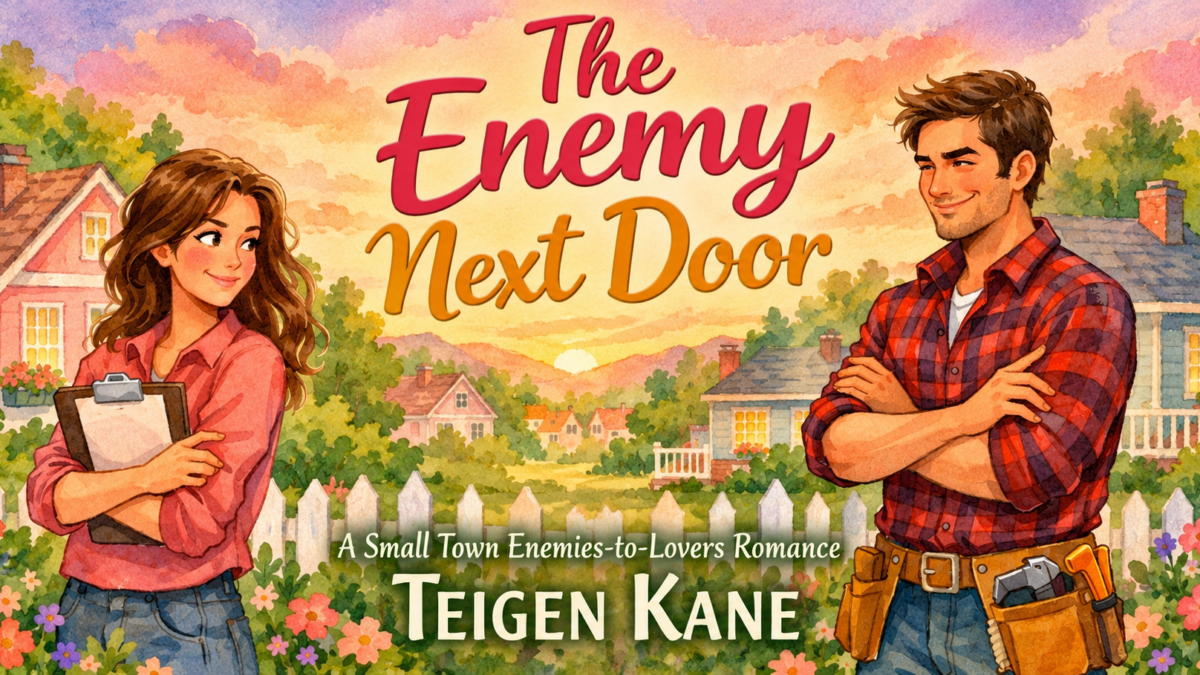
I resisted this trope for a long time.
Not because I didn’t love reading it. I did. I do. But every time I sat down to write one, I ran into the same wall: if two people genuinely can’t stand each other, why would either of them stay in the room?
Fake dating gives you a reason. Friends-to-lovers gives you years of history. Enemies-to-lovers gives you two people with every reason to walk away and no obvious reason to stay.
It took me three books to figure out the answer.
The trick isn’t the hate. It’s the proximity.
Here’s what I got wrong at first. I thought enemies-to-lovers was about writing sharper insults. Better comebacks. The verbal sparring people quote in reviews.
That’s the surface. The engine underneath is that neither of them can leave.
Something has to hold them in place. A shared property line. A business they both have a stake in. A small town where there’s exactly one coffee shop and you will see each other in it, every single week, whether you like it or not.
Once they’re stuck, the story writes itself — because people who are forced to keep showing up eventually see things they weren’t supposed to see. How he treats the woman behind the counter. How she is with her mother. The moment he does something decent when he thought nobody was watching.
You can’t hold onto a version of someone that the evidence keeps contradicting.
Why the ending feels earned
The reason this trope satisfies has nothing to do with the arguing and everything to do with what the arguing costs.
When two people who like each other fall in love, nobody has to be wrong. Nobody has to look at how they’ve been behaving and feel embarrassed about it. Enemies-to-lovers requires both of them to admit they misjudged someone — out loud, to that person’s face.
That’s genuinely hard. It’s hard in real life, which is why it lands on the page.
And it means the happily-ever-after is earned in a specific way. These two didn’t drift together. They had to dismantle something they’d both been carrying, on purpose, one piece at a time.
What I learned writing Wes and Quinn
The Enemy Next Door is my first real go at this trope, and it taught me something I didn’t expect.
The best enemies-to-lovers couples aren’t opposites. They’re too similar. Both stubborn. Both convinced they’re the reasonable one. Both absolutely certain the other person started it.
Write them as opposites and you get a pairing readers don’t believe in. Write them as two people with the same flaw pointed in different directions, and suddenly every fight is really them arguing with themselves.
That’s when it got fun.
It also helped that Copper Ridge is small enough that avoiding someone is a full-time job. A town that size does not let you nurse a grudge in private. Everyone has an opinion. Everyone is watching. And Ruthie, who runs the Daily Grind, has an opinion about everything.
Which moment got you?
If you’ve read The Enemy Next Door, I’d love to know which scene changed your mind about one of them. The moment you stopped taking sides and started hoping they’d work it out.
Email me at info@teigenkane.com. I read every single one, and knowing which scene landed tells me more than anything else could.
And if the book stayed with you, a review on Amazon helps other readers find it.
The Enemy Next Door, book two of the Copper Ridge series, is out now. If you haven’t met Copper Ridge yet, start with Faking It With My Childhood Best Friend — though every book stands on its own, so you can jump in wherever you like.
And if you’re not on my list yet, the Romance Readers Club gets new releases, behind-the-scenes notes, and the occasional confession about how badly a chapter fought me. Free book when you join.
